How to Create Team Alliances

Making Agile a Success
For successful Agile development, it is important that the entire team is prepared to keep the value delivery cycle going before development begins.
Why is such preparation necessary?
As the term “VUCA” suggests, today’s world is in an era of rapid change and unpredictability. In addition, it has become commonplace to own digital devices and there is an abundance of goods and services in the world.
In order to create value for users in such an era, it is no longer possible for the business side to come up with ideas and for the development side to create products that realize those ideas as instructed.
Nowadays, the business side and the development side are required to work together, think about what they need to do and act on their own toward the objectives and goals they need to achieve.
While it is not possible to create a self-organized team from the beginning, it is impossible to create a self-organized team without preparation. In order for a self-organized team to continue to deliver value, it must be well prepared before development begins.
The following eight preparations are necessary to create a self-organizing team.
-
Team Alliance
-
product goal
-
product backlog
-
road map
-
Definition of completion
-
working agreement
-
DevOps
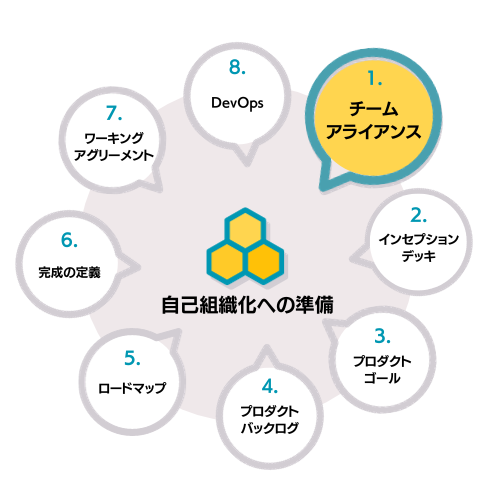
This article introduces one of them, Team Alliance.
What is Team Alliance?
A team alliance is the “ideal” that a team aspires to, meaning the team’s goal as a team.
In projects and products, too, a vision and goal are determined and promoted. In the case of Scrum, it is the product goal.
Why do we need Team Alliance?
To achieve the goals of a project or product, we need to truly come together as a team.
For Agile to be successful, in particular, it is important to be united as a team and to keep looking in the same direction in order to continue to explore and deliver value for users in a world that cannot be foreseen.
In 2016, a simple attempt to redefine the essence of Agile was made with the ” Modern Agile”. One of the principles described in Modern Agile is “Make people shine the brightest. The “people” referred to here include not only the users who provide value, but also the idea that the best products come from the best teams.
What does the best team need? I am sure that many factors may come to mind, but the first and most important is that the entire team has a common understanding of what the “best team” is. The first thing is to make sure that the entire team has a common understanding of what the “best team” is.
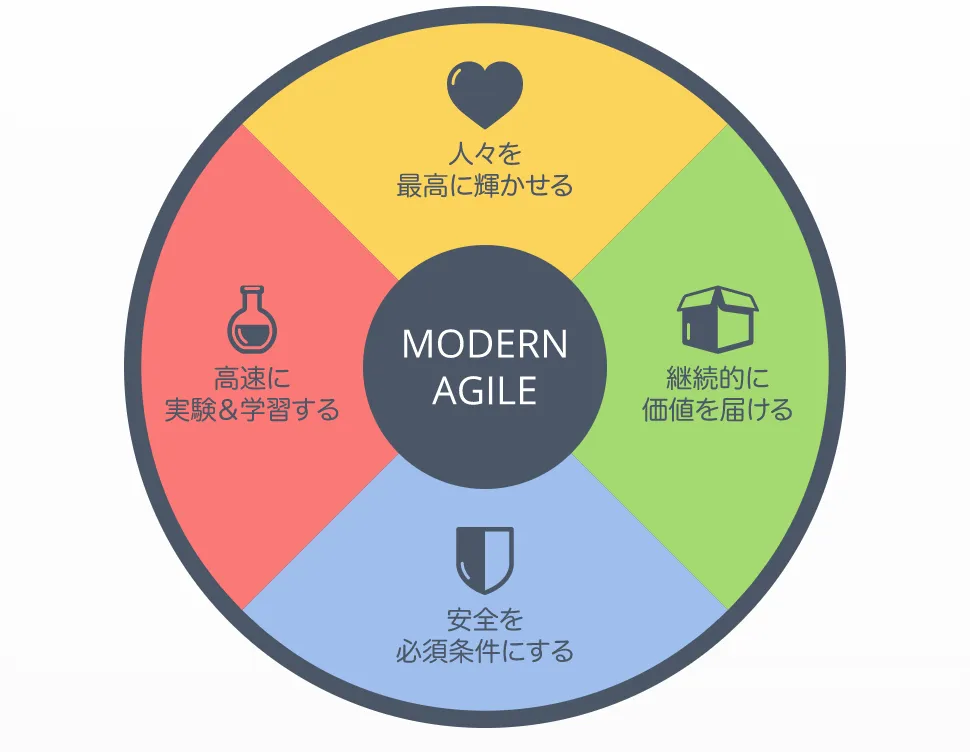
The Team Alliance is a useful tool to achieve a common understanding of this “best team.
When will the Team Alliance be ready?
It is best to conduct the meeting when the team has been established. By doing this before the team starts actual work, such as development, the team can share a common goal and start working on it. In the case of a scrum team, Sprint 0 is a good time to do this.
However, there must be many people reading this page who are already developing as a team. Some of you may be wondering if you will ever use Team Alliance. I am sure that many of you reading this page are already developing with a team.
Even if your team is already underway, it is important to have a common understanding of what you want your team to be, and it will be effective for your future efforts.
In that sense, it does not matter at what point in time you use Team Alliance, it will benefit your team.
Benefits of Preparing a Team Alliance
The following benefits can be expected from having a team alliance for agile teams.
Leads to motivation for the entire team
When the team’s ideal state is set out and a common understanding of where the team is aiming for is established, an intrinsic motivation to achieve it is created, and the entire team will be highly motivated to work on development.
When the team is faced with a decision, it can be confirmed as a policy for how to behave as a team.
When the team is faced with a decision as it works as a team, it can confirm the team’s policy in the team alliance and make a decision.
You can check which decisions should be made in order to achieve the team’s ideal state, and how the team should behave as a team when faced with difficulties.
It can also be used as a reflection point of view.
It can be used as a theme in a reflection, such as a retrospective in Scrum, to check whether the team is moving toward the desired state that it has set.
It can also be used as an opportunity to review what has been set as a team alliance based on the results of the review.
How to Create Team Alliances
Please refer to our helpful documents for information on how to actually create team alliances!