
Introduction of “Basic UX Design Training

In this issue, we will introduce “UX Design Basic Training,” in which participants learn the basic elements of UX design through lectures and practices, from among the UX design-related training programs offered by TDC SOFT.
What is UX Design?
The literal translation of the term “UX (user experience)” is “user experience. User experience refers to the experience that a user has while learning about a product, system, or service, while using it, and while looking back on it after use. In other words, all experiences that occur while users are aware of a product, system, or service, even if they are not using it, can be considered UX. At TDC SOFT, we interpret UX design as “understanding and empathizing with the user in essence, and thinking about things rather than things.
Similar to UX (user experience) design, UI (user interface) design is a term used to refer to the experience that a user has while using a product, system, or service. design. The two terms are closely related, but different: UI design refers to the design of the parts of a product, system, or service that are involved in “the operations and means to achieve some objective when using the product, system, or service,” and deals with the ease with which information is conveyed, appearance, color scheme, etc. UX design, as mentioned earlier, is the design of the parts of a product, system, or service that are used before, during, and after use. UX design refers to all the experiences that occur during the perception of a product, system, or service, including before and after its use. Therefore, it is important to understand that UX design encompasses UI design.
What you will learn through the training
The need for design personnel is becoming increasingly important in today’s business scene. The Ministry of Economy, Trade and Industry (METI)(*) and many other companies are making efforts to develop design human resources. (*Source : Research and Study Report on the State of Advanced Design Human Resource Development, Summary Version (Ministry of Economy, Trade and Industry 2019) )
In the past, when creating a product or service, it was possible to attract users by incorporating excellent functions or making the price low. However, in today’s world of overflowing goods, it is becoming increasingly difficult to attract people with functionality and price alone. Nowadays, it is important to understand users’ potential issues and their true needs and expectations. Providing solutions that meet these needs will lead to an experience that satisfies the user. Providing a “user-satisfying experience” will differentiate you from your competitors, help you achieve your business goals, and increase your corporate value. This training course is designed to provide participants with the correct knowledge of UX design and practical methods, and to enable them to think about “user-satisfying experiences”.
Point 1: No design or IT experience required! Lectures that anyone can understand
The curriculum of this training program consists of a 1-hour lecture and a 6.5-hour workshop to deepen understanding through experience.

Two efforts have been made to ensure that even first-time students can properly understand the lecture content.
Explain the definition of words so that participants will have a correct understanding of them.
The lecture begins with an explanation of the mindset for practicing UX design, what it means to be user-centered, and why UX design is necessary. Once all participants understand why UX design is necessary and what user-centeredness is, the definition of UX in ISO standards and TDC Software’s interpretation will be explained.
In addition, many people in the world still misunderstand that UX = UI. With the wrong understanding, they may make mistakes in their approaches or fail to achieve sufficient results. To ensure that participants have a correct understanding of the difference between UX and UI, we also explain the difference between UX and UI.
Point 2|Introduction of design flow and methods with examples
The lecture will explain what kind of thinking and methods should be used when designing UX. Since many of the participants are interested in practicing UX design, we will also explain the value and benefits of UX design, as well as case studies of UX design. After the lecture, participants will understand the definition, concept, methodology, value, and benefits of UX design, and then we will move on to the workshop.
Point ➁ Workshop to experience a series of UXD process
In the workshop, participants are divided into groups of 3~5 to practice a series of UX design. Since there are some points that cannot be successfully practiced or stumbled over in a lecture alone, the instructor visits each group to promote knowledge retention and follow up on the work.
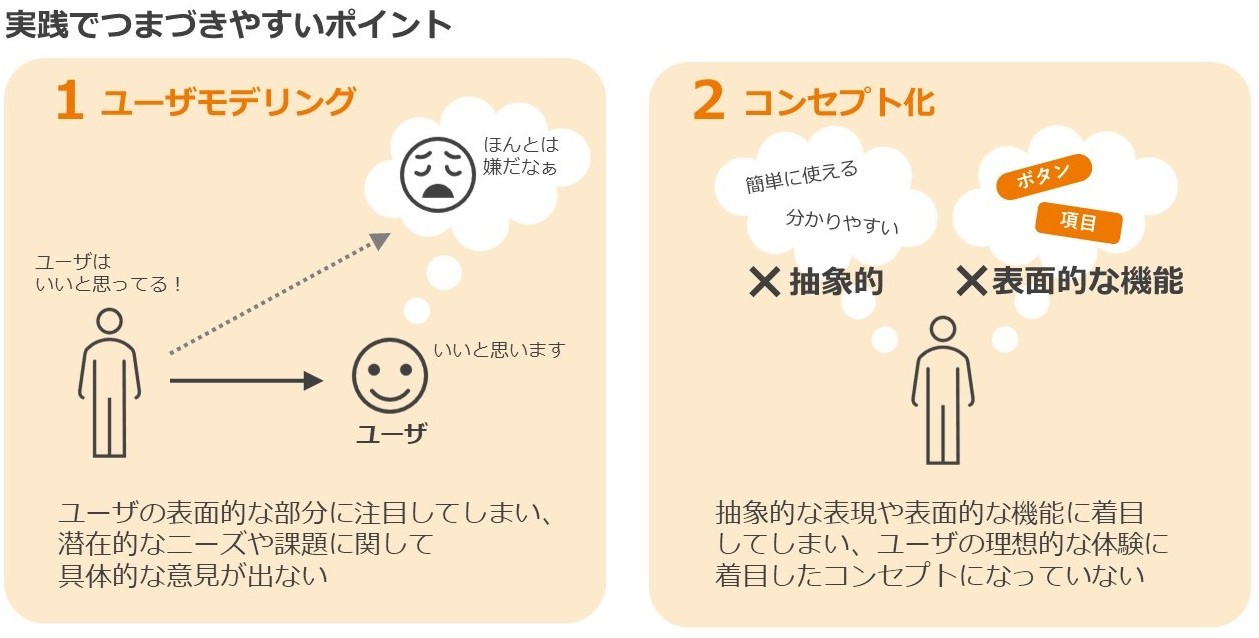
The first point that can easily trip you up in practice|User Modeling
The first point is user modeling, which is the process of understanding and digging deeper into the users targeted by the group and creating a common understanding among the group. User modeling is an important part of the UX design process, as it influences the entire flow of the UX design process. When imagining the words and actions of a user in a certain situation, it is necessary to align the group’s understanding until everyone’s ideas are in agreement. The superficial needs of the users are easy to grasp and opinions are easily expressed within the group, but when latent needs and issues that the users themselves are unaware of are derived, it is a very difficult point where specific opinions are difficult to come up with.
In the workshop, the group clarifies target users by considering not only the superficial behaviors of users, such as what kind of life they usually lead and what kind of things they are interested in, but also the deeper aspects of users, such as why they say and do what they do and what kind of values they have. During the work, the instructor facilitates the group to gain insight and find new directions, so that even first-time learners can achieve solid results.
The second point that can easily become a stumbling block in practice|Conceptualization
The second point is conceptualization, which is the process of finding a direction for what kind of experience should be provided in response to the potential needs of the users discovered. The concept defines the direction of the experience to be provided, but when first considered, it is often expressed in an abstract manner and the direction is blurred. In addition, first-time developers may focus on the superficial functions and UI parts of the system, product, or service, and the concept may not be focused on the ideal experience for the user. If a product or service is created without a refined concept, it will lead to the creation of something that will not be appreciated by users.
Within the workshop, the instructor will provide support in verbalizing issues and experiences, abstracting/concretizing, and advising on concept syntax. We are devising ways to make the most of the training experience in the real world. After the workshop, the group develops ideas for the experience to be provided, actually expresses them as prototypes, tests them with users, makes improvements based on the evaluation results, and tests them again. The instructor provides support throughout the curriculum so that participants can deepen their understanding.
Creative training hours
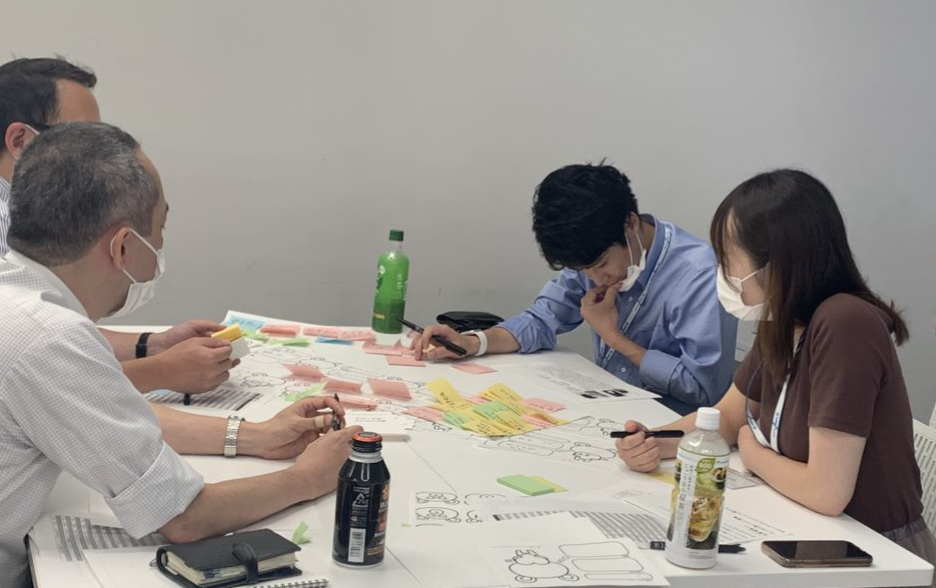
In the training, participants with different backgrounds and perspectives work as a team and cooperate with each other. The atmosphere, as well as the actual work, often leads to the discovery of new ideas and perspectives that one might not have noticed on one’s own. When actually designing, rather than having one excellent designer think everything through, it is often necessary to collaborate with a variety of people and consider the experience that will please the user. The necessity and effectiveness of this approach can be felt in the training.
At first, some participants feel that the 6.5-hour workshop is a long time, but when they seriously think about the users, create an experience that will please them, and receive evaluations, the instructors are often overwhelmed by the enthusiasm of the participants, who at the end of the workshop wonder what was missing and what could be done better. After the workshop, participants are so enthusiastic that they all say, “There are still things I haven’t noticed about users,” or “I wish I could have done more.
Testimonials from Students
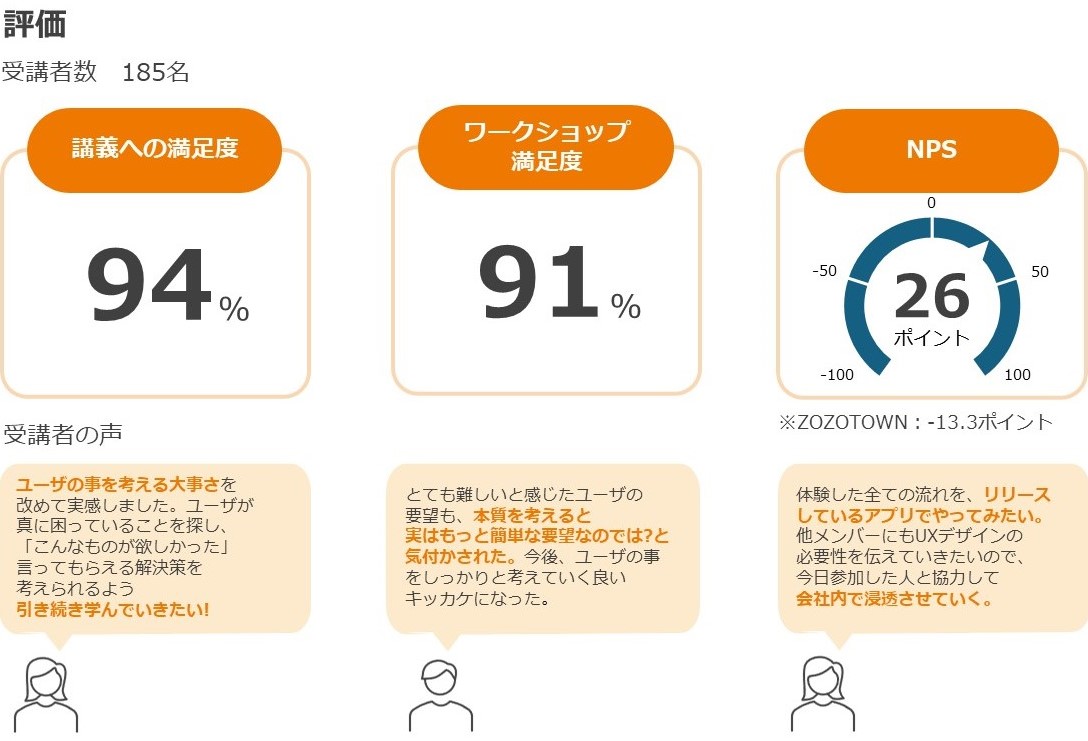
Although it is a one-day training course, many participants feel that they can make use of it in their work, and some have expressed their desire to have their members who could not attend the course take it and to expand it.
Some of the results of the survey from the participants are presented below.
In addition to “UX Design Basic Training,” TDC Software offers UX Design Basic Training, as well as training in other processes and areas, The company also offers training for each process and domain, and can customize the content of each training course and select the training style (online or offline). In addition to UX design, we also offer training in the fields of Agile and security.
If you are interested in our services, please contact us. Click the button below to contact us.
Technologies Used

UX Design
We provide support using a variety of UX design techniques to help you deliver an experience that truly delights you and your users.