
Introduction of “Usability Testing Training

TDC SOFT Inc. offers a variety of UX design-related training programs. In this issue, we will introduce “Usability Testing Training,” where participants learn through practice. In this training course, participants learn the basic concepts of usability testing, and then learn practical techniques by using actual websites and applications and experiencing testing in a workshop.
What is Usability Testing?
Usability testing is conducted before/after the release of a product or service, and is designed to identify new usability issues and areas for improvement by recording and observing how users use and perceive the service.
What is the difference from heuristic evaluation?
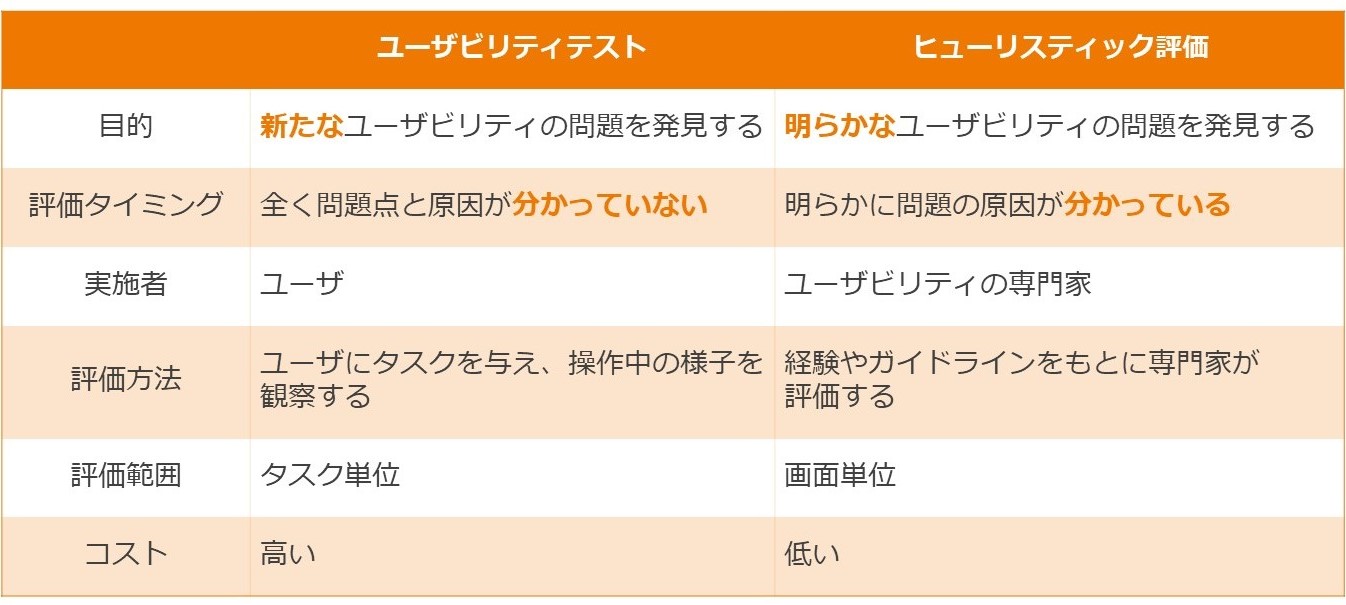
There is another type of test to find usability problems: heuristic evaluation. In a heuristic evaluation, experts evaluate a design or interface based on general usability principles and best practices. After a heuristic evaluation is conducted to identify and correct obvious problems, usability testing is recommended. The differences between usability testing and heuristic evaluation are as follows
What you will learn through the training
It is a matter of course, but before creating a system, product, or service and releasing it to the market, it must be thoroughly evaluated to ensure that it meets the needs of users, is user-friendly, easy to use, and can achieve its objectives without stress. In the unlikely event that the evaluation process is inadequate and a major usability flaw is overlooked, users may become dissatisfied with the product or service and stop using it. To prevent such a situation, it is important to understand how users behave and think under what circumstances, and to remedy usability problems in advance.
With this in mind, TDC SOFT Inc. offers “usability test training” to help you learn how to obtain evaluation from users in advance and to gain correct knowledge about usability.
Point 1: "Task design" that thoroughly considers the user's point of view
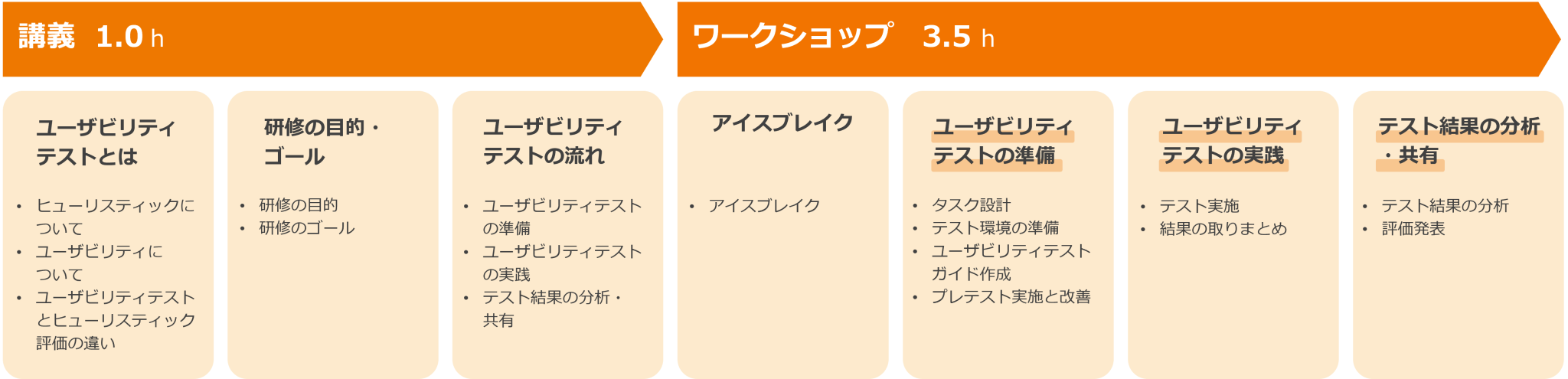
The curriculum of this training, which consists of 1 hour of lecture and 3.5 hours of workshop, is designed to deepen understanding through practice and enable participants to increase the speed and quality of usability problem finding.
One of the most common stumbling blocks in usability testing is “task design,” which must be thoroughly considered from the user’s perspective. A task is an action that a user takes to reach a goal that he or she wants to achieve with a product or website. In usability testing, we communicate the task to the user and observe their behavior during the task implementation. Therefore, it is necessary to accurately convey the task to the test subjects. If the quality of the task is poor, users may stumble during the test, or it may not adequately reflect real-world usage conditions, making it difficult to find meaningful problems. Task design should emphasize the user perspective and incorporate perspectives such as “why do they use this product or website?” and “what goals are they trying to achieve?” from the standpoint of concrete users. To achieve this, it is necessary to abandon the provider’s point of view, give top priority to the user’s point of view, and provide tasks based on concrete and realistic user behavior patterns that are in line with actual usage scenarios.
In this training course, participants design tasks while the instructor facilitates, allowing them to recognize errors at an early stage. In addition, the curriculum is designed to verify whether users can perform the tasks by pre-testing the tasks actually listed in the pre-test. By applying the methods learned in this training course to the actual task design, participants will be able to naturally identify and improve problems in task design, and will be able to extract valuable test results.
Point ➁ Workshop to realize the importance of the user perspective
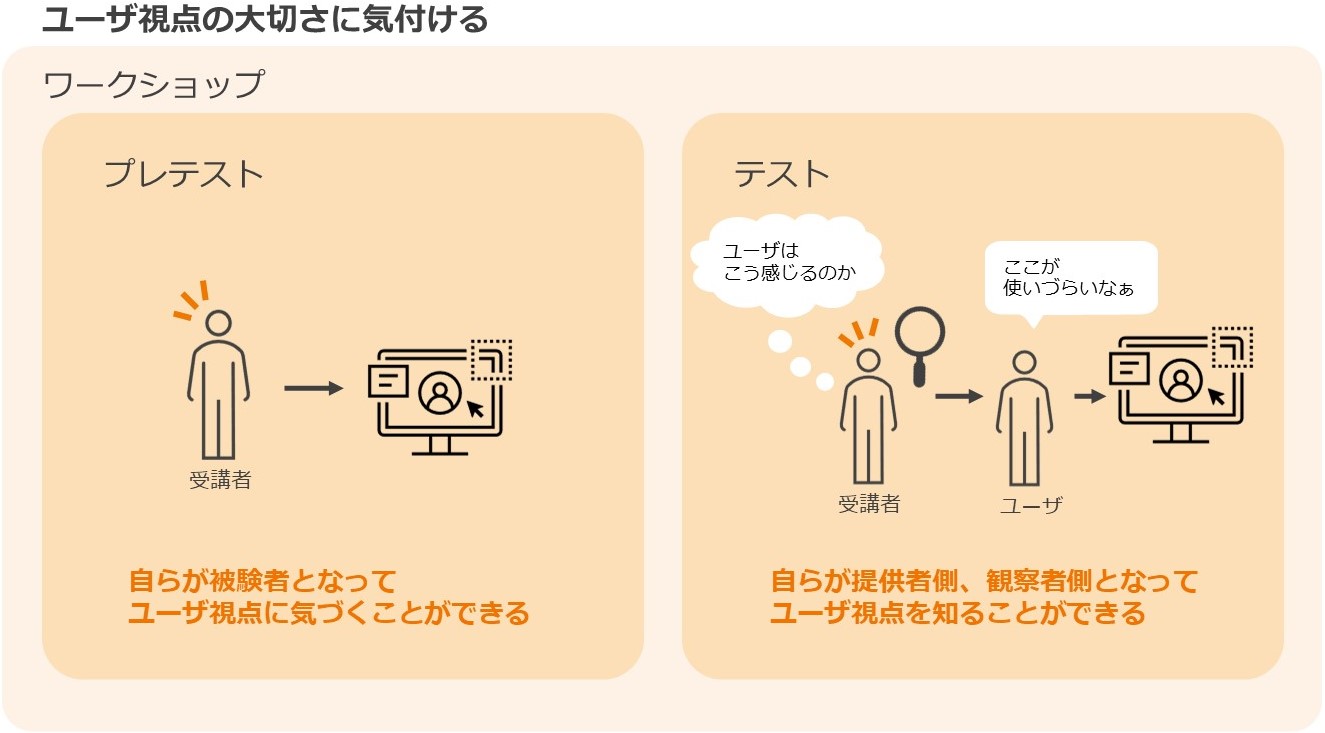
The second feature of this training course is that it helps participants realize the importance of the user’s point of view. In order to verify whether the tasks designed by the participants can be tested correctly, a pre-test is conducted by inviting participants from among the participants. By conducting the pre-test, we can discover areas in the tasks we have designed that users may encounter stumbling blocks or that are difficult to understand. After the pre-test, the tasks are improved so that they can be implemented by users, and in the process, the importance of the user’s perspective is reaffirmed.
In addition, when users execute the test, they may have questions or stumble over scenarios that should have been improved. Participants will see how much their own hypotheses diverge from those of actual users, and will learn even more about the importance of the user’s point of view. This experience is difficult to obtain without actually going through the workshop. Many participants commented in the post-workshop questionnaire that the workshop “helped me to realize how much I had been lacking in the user perspective. We believe this is a result of the fact that each participant was able to realize the importance of the user’s viewpoint through practical experience.
In this way, TDC SOFT Inc. designs its training programs to be practical, so that participants can learn anew the importance of addressing problems discovered through the actual actions and reactions of users.
Voices of Training Participants
Although it is a half-day training, a great number of participants said that they began to think about the users not only during testing, but also while they are making the product. Some of the survey results from the participants are presented below.
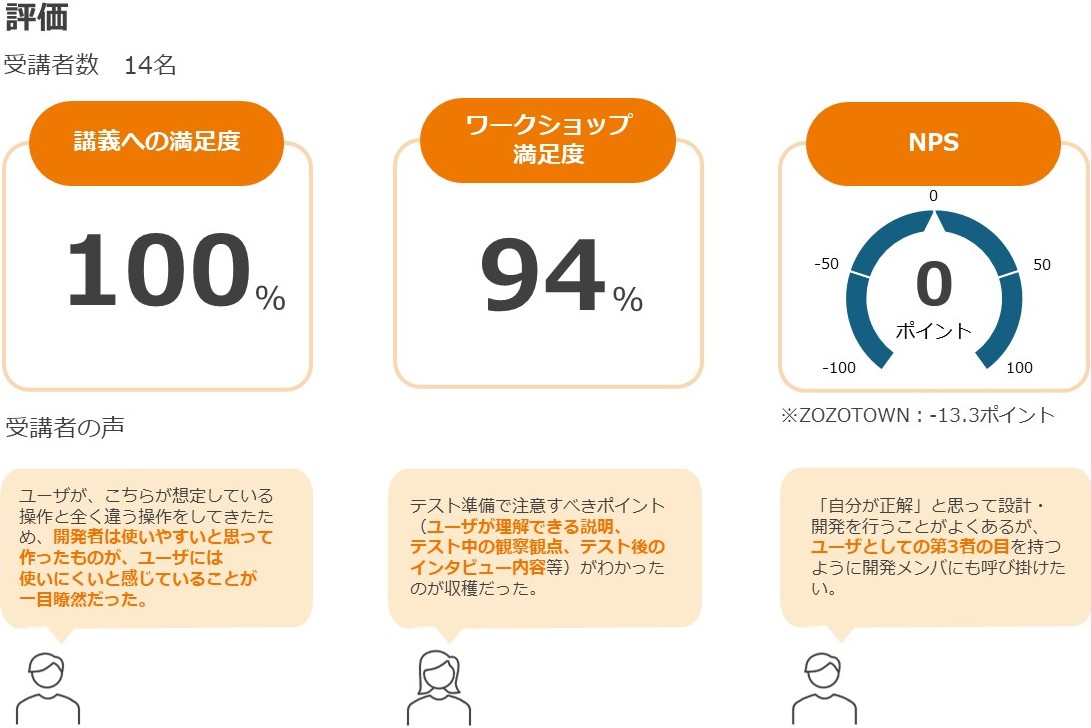
TDC SOFT Inc. listens to the voices of users and continues to make improvements so that participants can make the best use of the training in the real world. In addition to UX design, we also offer training in the fields of agile and security.
If you are interested in our services, please contact us. Click the button below to contact us.
Technologies Used

UX Design
We provide support using a variety of UX design techniques to help you deliver an experience that truly delights you and your users.