How to Create Product Goals

Making Agile a Success
For successful Agile development, it is important that the entire team is prepared to keep the value delivery cycle going before development begins.
Why is such preparation necessary?
As the term “VUCA” suggests, today’s world is in an era of rapid change and unpredictability. In addition, it has become commonplace to own digital devices and there is an abundance of goods and services in the world.
In order to create value for users in such an era, it is no longer possible for the business side to come up with ideas and for the development side to create products that realize those ideas as instructed.
Nowadays, the business side and the development side are required to work together, think about what they need to do and act on their own toward the objectives and goals they need to achieve.
While it is not possible to create a self-organized team from the beginning, it is impossible to create a self-organized team without preparation. In order for a self-organized team to continue to deliver value, it must be well prepared before development begins.
The following eight preparations are necessary to create a self-organizing team.
-
product goal
-
product backlog
-
road map
-
Definition of completion
-
working agreement
-
DevOps
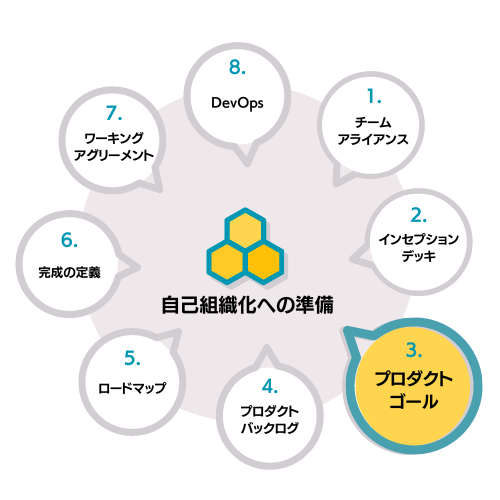
This article introduces one of them, the Product Goal.
What is the product goal?
Product goals are a new introduction in the Scrum Guide, which was updated in 2020. In that Scrum Guide, they are explained as follows
The product goal represents the future state of the product. It is the target of the scrum team’s plan. The Product Goal is included in the Product Backlog. The rest of the product backlog defines the “what” that will achieve the product goal.
A product is a means to deliver value. A product has clear boundaries, known stakeholders, and clearly defined users and customers. A product can be a service, a physical product, or something more abstract.
The product goal is the long-term goal of the Scrum team. Before moving on to the next goal, the Scrum team must achieve (or abandon) one goal.
https://scrumguides.org/docs/scrumguide/v2020/2020-Scrum-Guide-Japanese.pdf
In summary, the following is a summary
-
The product goal is the future state of the product and is the long-term goal of the scrum team
-
Product goals are included in the product backlog
-
The product goal is “why” and the rest of the product backlog (list of items) is “what
In other words, the Product Goal is the goal that the team aims for when developing a product in Scrum.
Product Goal is a concept defined in Scrum, but it can also be used in Agile development in general to define the “What is the goal? It is a good idea to set the goal even when you adopt a framework other than Scrum, because it defines and promotes a common understanding of what the goal is.
Why do we need product goals?
Before explaining why product goals are necessary, we will look at the Scrum value criteria as defined in the Scrum Guide.
Scrum sets five value criteria: assurance, focus, openness, respect, and courage, and the success of Scrum depends on how well these are realized.

Product goals are “commitments” for the team. Commitment” does not mean that the team will achieve the set goal, but rather that the team is “committed” to working toward the goal to the best of its ability.
The “commitment” of a goal helps to create intrinsic motivation in the team. Intrinsic motivation is a type of motivation that is drawn from a person’s own interests, and is something that makes him or her feel a sense of fulfillment, contribution, and growth.
The entire team should be motivated to “deliver great value to the users by achieving this product goal! By setting a product goal that motivates the entire team to “deliver great value to our users by achieving this product goal,” we can expect the team to become a self-directed team that takes initiatives on its own.
Product goals can also create another value criterion, “focus.
By focusing on achieving product goals, you can continue to encourage kaizen and growth in the expertise and skills needed to achieve them, and in how you work as a team.
When will the product goal be ready?
You will probably prepare a backlog as a source of information for the actual development of the product (product backlog in Scrum). Before preparing this backlog , you should formulate the product goals.
As described in the section “What is a Product Goal?” chapter, in Scrum, the product goal is a part of the product backlog and corresponds to the “why” part. Therefore, it is required to set the Product Goal at the stage of preparing the product backlog.
It is recommended to prepare the Product Goal before starting an iteration in Agile.
Benefits of preparing product goals
The following benefits can be expected from setting a product goal with the team.
The team and all the people involved can share a common understanding of what they are aiming for.
The product goal is the “objective” of the product development process. Whether or not the team and all related parties share a common understanding of the goal is the key to successful product development. In addition, setting a product goal is not the end of the process, but an opportunity to periodically check the product goal during the iteration process will ensure that the product is always developed with the goal in mind.
It will serve as a benchmark for creating backlog items.
With goals set, what things need to be realized to achieve them? What items are needed? It is easier to prepare items in terms of
It is an indicator for ordering back log items
In considering the order in which to arrange backlog items, which items are more important to achieve the product goal? This can be used as an indicator for ordering the backlog items.
How to Create Product Goals
Please refer to the useful materials on how to actually create product goals!