How to build an inception deck
Making Agile a Success
For successful Agile development, it is important that the entire team is prepared to keep the value delivery cycle going before development begins.
Why is such preparation necessary?
As the term “VUCA” suggests, today’s world is in an era of rapid change and unpredictability. In addition, it has become commonplace to own digital devices and there is an abundance of goods and services in the world.
In order to create value for users in such an era, it is no longer possible for the business side to come up with ideas and for the development side to create products that realize those ideas as instructed.
Nowadays, the business side and the development side are required to work together, think about what they need to do and act on their own toward the objectives and goals they need to achieve.
While it is not possible to create a self-organized team from the beginning, it is impossible to create a self-organized team without preparation. In order for a self-organized team to continue to deliver value, it must be well prepared before development begins.
The following eight preparations are necessary to create a self-organizing team.
-
inception deck
-
product goal
-
product backlog
-
road map
-
Definition of completion
-
working agreement
-
DevOps
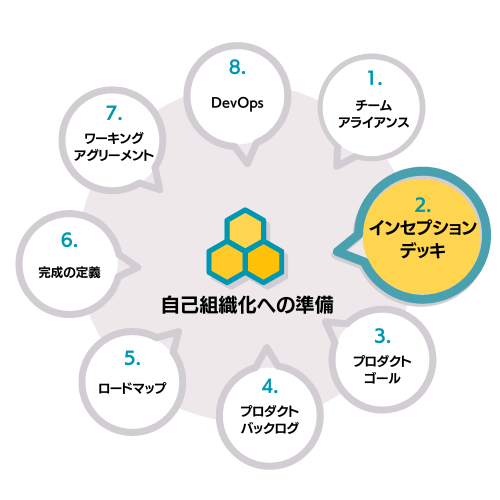
This article describes one of them, the Inception Deck.
What is an inception deck?
The inception deck consists of 11 questions designed to help the team clarify the goal and its context for common understanding.
-
Why are we here?
-
Elevator Pitch
-
Package Design
-
List of things not to do
-
Find your neighbors.
-
Technical Solution
-
What is it about these issues that keeps us up at night?
-
Our A-Team
-
Determine the duration
-
Be clear about what you are willing to give up (trade-off slider)
-
What is needed and how much
It is said that sharing an image with the team will lead to success, and the inception deck can help. By discussing and creating answers to the 11 questions with the entire team, a common understanding can be achieved.
The Team Alliance created in the previous session will serve as a guide when you are unsure of how to proceed as a team state. In contrast, the Inception Deck will serve as a guideline when a project or team is unsure about how to proceed with development.
Why do we need an inception deck?
It is important that all team members have the same image of the project.
If an inception deck has not been created, the images held by each team member may be out of sync. If each team member thinks of a new feature based on his or her own concept of what he or she envisions, the project will lose a sense of unity and will be inconsistent.
Creating an inception deck clarifies the problems behind what you want to accomplish and what you want to solve, so there are no differences in perception among team members and a sense of unity can be created.
Thus, without an inception deck, the opportunity for common understanding is lost, and team members may be unaware that they are proceeding under different policies. In this respect, creating an inception deck gives all team members the opportunity to discuss and eliminate any discrepancies and to have the same image of the project. An inception deck is necessary for the team to reach a common understanding.
When will the inception deck be ready?
It is best to conduct the meeting when the team has been established. By doing this before the team starts actual work, such as development, the team can share a common goal and start working on it. In the case of a scrum team, Sprint 0 is a good time to do this.
Benefits of having an inception deck
The following benefits can be expected from having an inception deck for your agile team
Learn about the team’s goals and the background behind them.
Of the 11 questions, the first question, “Why are we here?” will discuss the target and the background that led to the team’s goal. Rather than just vaguely trying to achieve the team’s goal, it is more motivating for the team to understand the background as well.
When you are faced with a decision as a team, you can check what you should focus on.
When you are faced with a decision as a team working on a project, you can check the priorities visualized in the Inception Deck and make a decision. In addition to the trade-off slider, the Inception Deck also provides a list of do’s and don’ts, so you can easily determine whether you should do something or not.
Know what is expected of the team and each team member.
You can identify the people involved within the team as well as those outside the team, making it easier to collaborate with those outside the team. In addition, you can organize the roles of team members and what is expected of them.
Regular common understanding
common understanding is important for the success of the project. The inception deck should be reviewed and revised regularly by all team members. Through periodic review and revision, the team can develop a common understanding each time, and this can also improve teamwork.
How to build an inception deck
Please refer to our helpful documents for information on how to actually build an inception deck!