Learn Agile in 4 hours! Scrum Training Participation Report
What is Agile, and how would you answer if asked? Agile is often thought of as a methodology for system development, but in fact it is an effective way to influence the entire organizational structure and deliver better value to customers. For companies that want to incorporate Agile into their projects but do not know where to start, or want to know what Agile is in the first place, I recommend TDC SOFT’s “Scrum Training: The Basics.
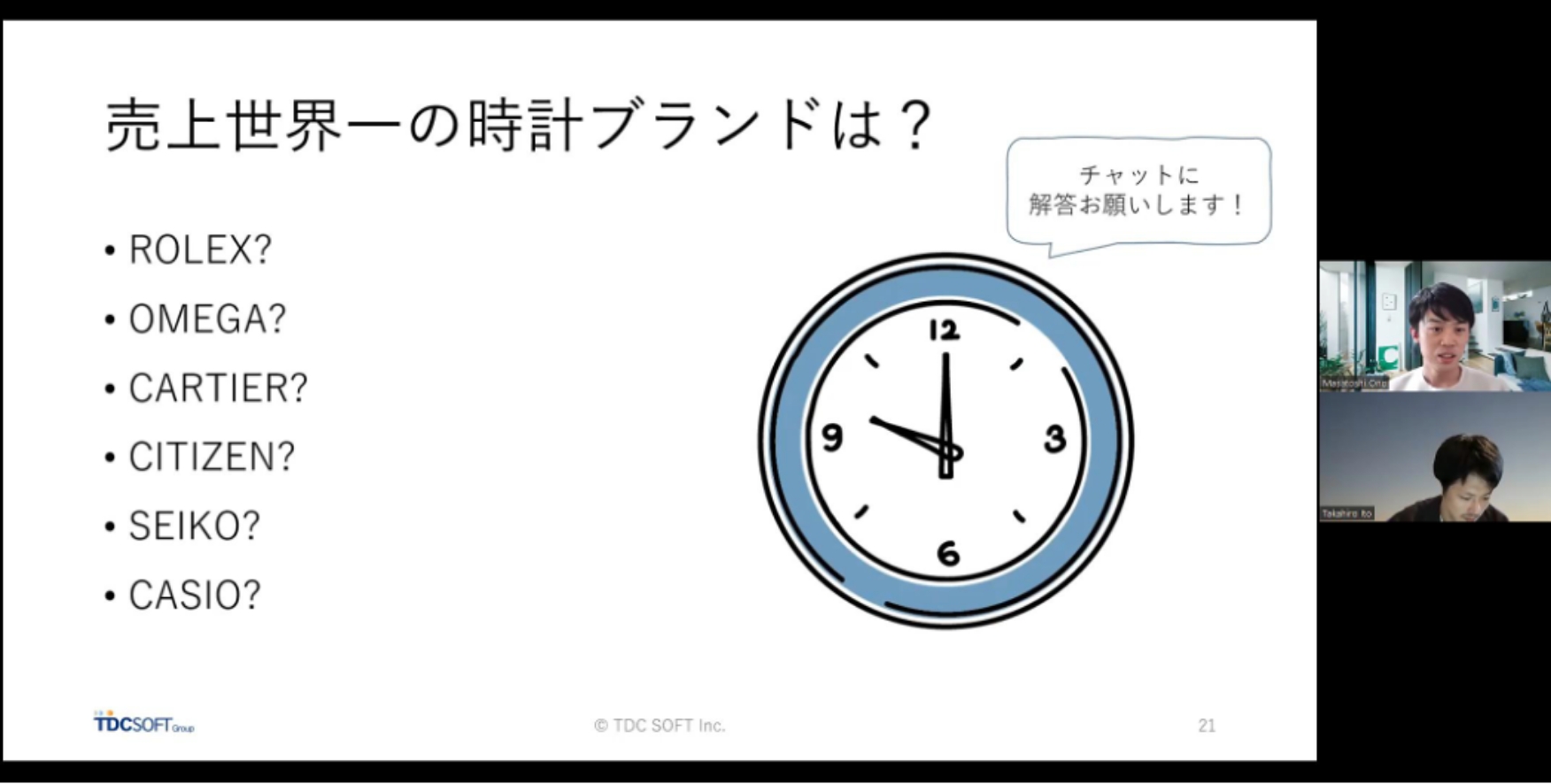
Inserting quizzes and question-and-answer sessions to keep the learning process interesting.
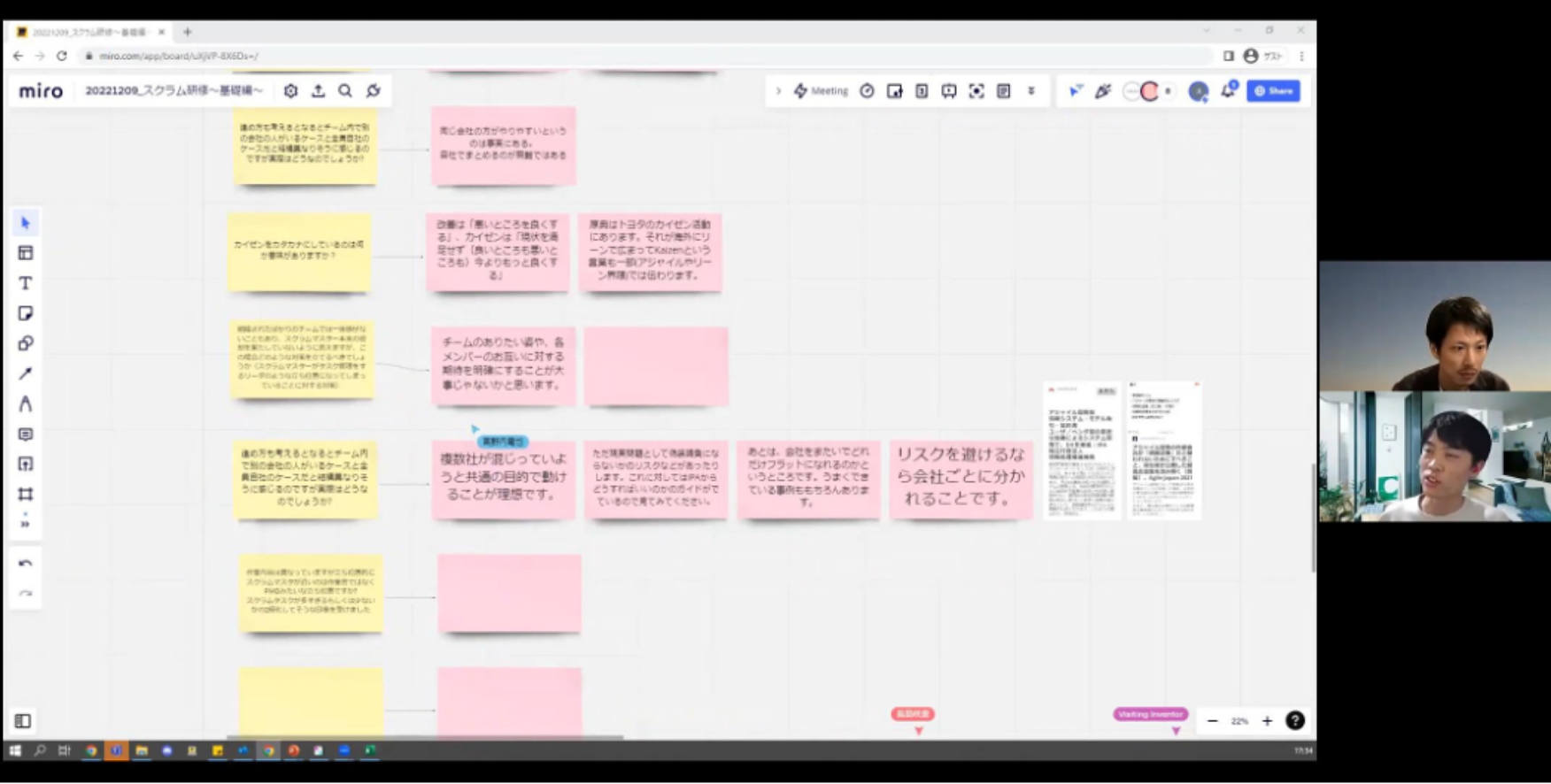
The training, conducted online, makes full use of web conferencing tools and online whiteboards. In addition to projecting the lecture content, questions were answered on sticky notes on the whiteboard. Regarding questions, the instructor strongly appeals, “Questions are not a shame, but a learning experience for everyone. I urge you to ask questions proactively. Transparency is an important keyword in Agile and Scrum. In order to foster an agile mindset, questions filled in on the whiteboard were answered for everyone. There were more than a dozen participants, and four teams were formed to conduct the workshop.
At the beginning of the session, the participants were first asked about the purpose of their participation in the training. In response, the lecturer explained in an easy-to-understand manner that in the age of VUCA (volatility, uncertainty, complexity, and ambiguity), one cannot survive without Agile, using examples such as changes in market share in various industries. He then introduced the basic concept of Agile: “Don’t just do agile, be agile. In other words, he stressed the importance of an agile mindset in addition to practicing agile processes.
What was impressive about the way he proceeded from the beginning was that he did not just explain one-sidedly, but used interactive communication to arouse interest. Quizzes and questions inserted from time to time kept the audience interested and focused throughout the four-hour session. In terms of content, I was impressed by the explanation that “the Agile concept is a universal one that can be used from the management strategy level. I realized that “Agile is not a development method,” and my impression of Agile changed drastically from the beginning.
Understand the concepts for being agile.The quizzes that appear unexpectedly also provide hints for understanding.
Real-life lectures by actual Agile project members
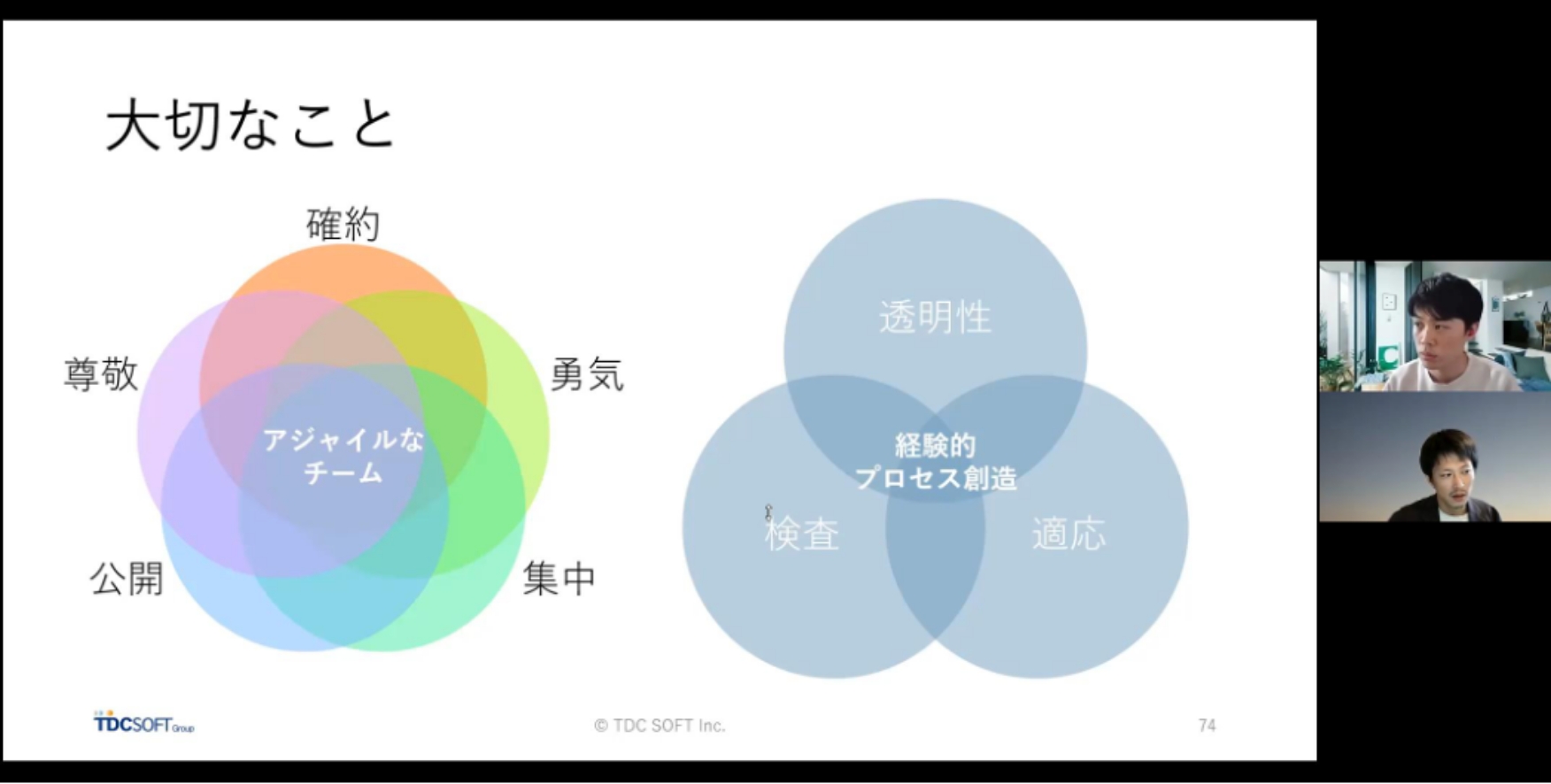
Teams were then divided into teams for a 10-minute breakout session. They introduced themselves, decided on team names, and discussed their impressions of Agile. Then it was back to the lecture to learn about “scrum” to facilitate agile. He introduced the importance of an exploratory approach in this age of VUCA, where the future is uncertain, and that Scrum is best suited for this purpose, as it is optimized through repeated cycles of practice and reflection. He said that this approach leads to experiential process creation.
What I felt in this part of the lecture was that the lecturers were actually working on agile projects, and the lecture content was very convincing. The lecturers also talked about Scrum failures, and it was obvious that Scrum is not the answer to all problems. In terms of content, I was impressed by the point that “development through the Scrum process does not = agile development. As in the previous section, this is not a mere methodology or technical theory, but rather an easy-to-understand and repeated presentation of the concept, and I felt that the fundamental ideas that are difficult to understand just by reading explanatory books can be acquired.
During the course of the training, the participants will be divided into breakout rooms as appropriate, and team-based discussions will be held.
Experience Scrum in a heated workshop
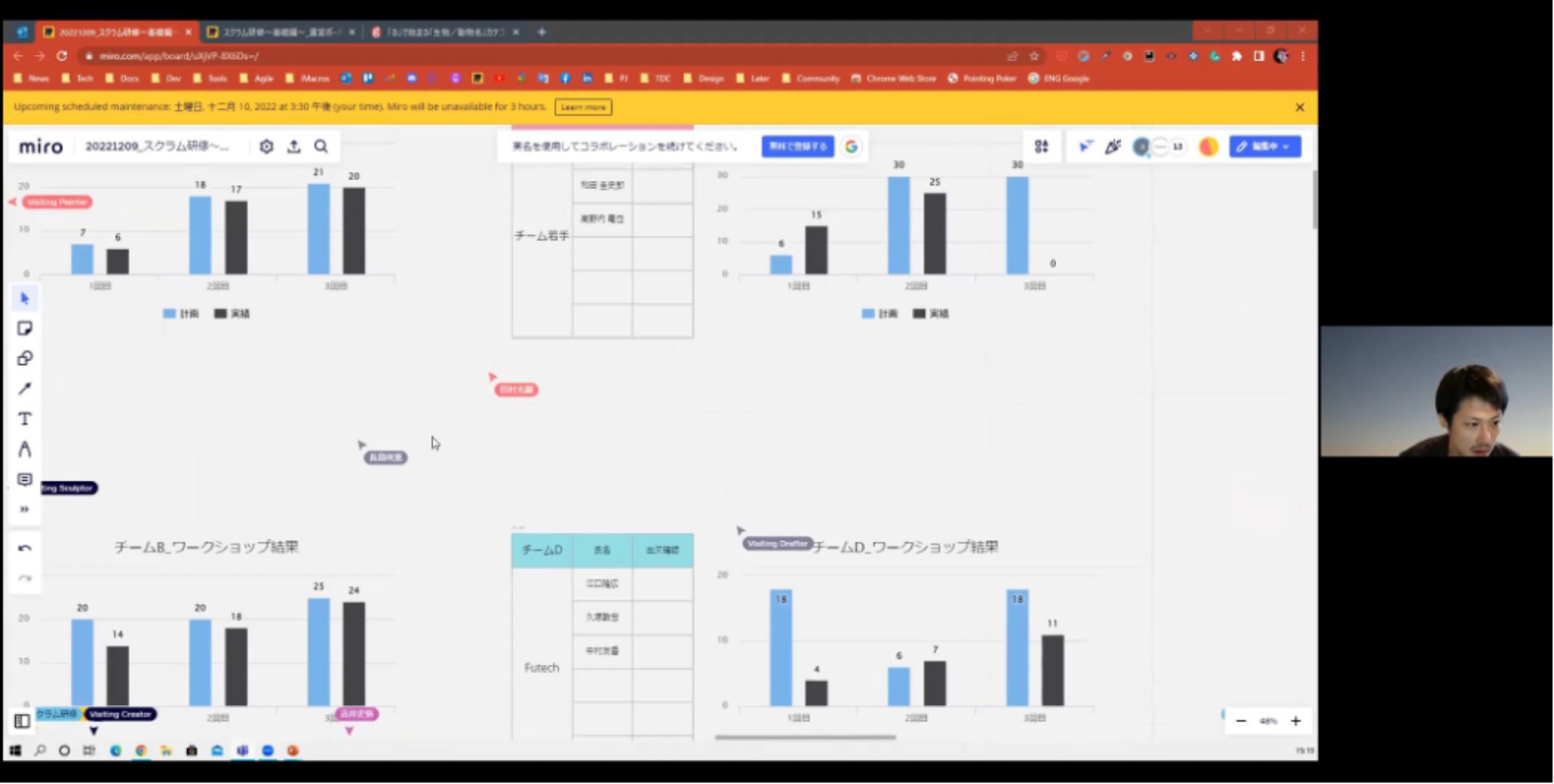
From here, we moved on to the highlight of the training, the Scrum workshop. In order to experience the image of Scrum, the participants were divided into teams to work. A unique “subject” was given, and the cycle of planning, working, reviewing, and looking back was repeated three times. By repeating the same process, the participants tuned their goal setting and work procedures, and tried to kaizen their results. As a result, all teams improved their performance and the deviation from the target was reduced. At the end of the workshop, the teams discussed their findings and wrote them on the whiteboard, which was then critiqued by the instructor, who also introduced tips for achieving better results that were not included in the workshop.
Although the workshop topic was a simple task that anyone could do, it was more heated than expected. Each time the cycle was repeated, the experience of each team increased, and it was visible that collective knowledge was created. It was interesting to hear the team members’ comments, such as, “I was able to realize growth through repeated planning and review,” and “A sense of unity was created by working together toward a goal. As a further hint for achieving results, the instructor commented, “It is also meaningful to try communication with the instructor to confirm or relax the rules. If you replace the lecturer with the client, it can be effective in actual projects.
A break was inserted after the workshop, the duration of which was decided by asking the participants about their intentions. Since Scrum aims for an autonomous organization, it was felt that the participants tried to enhance their autonomy as much as possible during the training.
The results of each team are visualized in real time.Sticky notes on the white board to share Q&A with everyone.
Training content applicable to a wide range of businesses
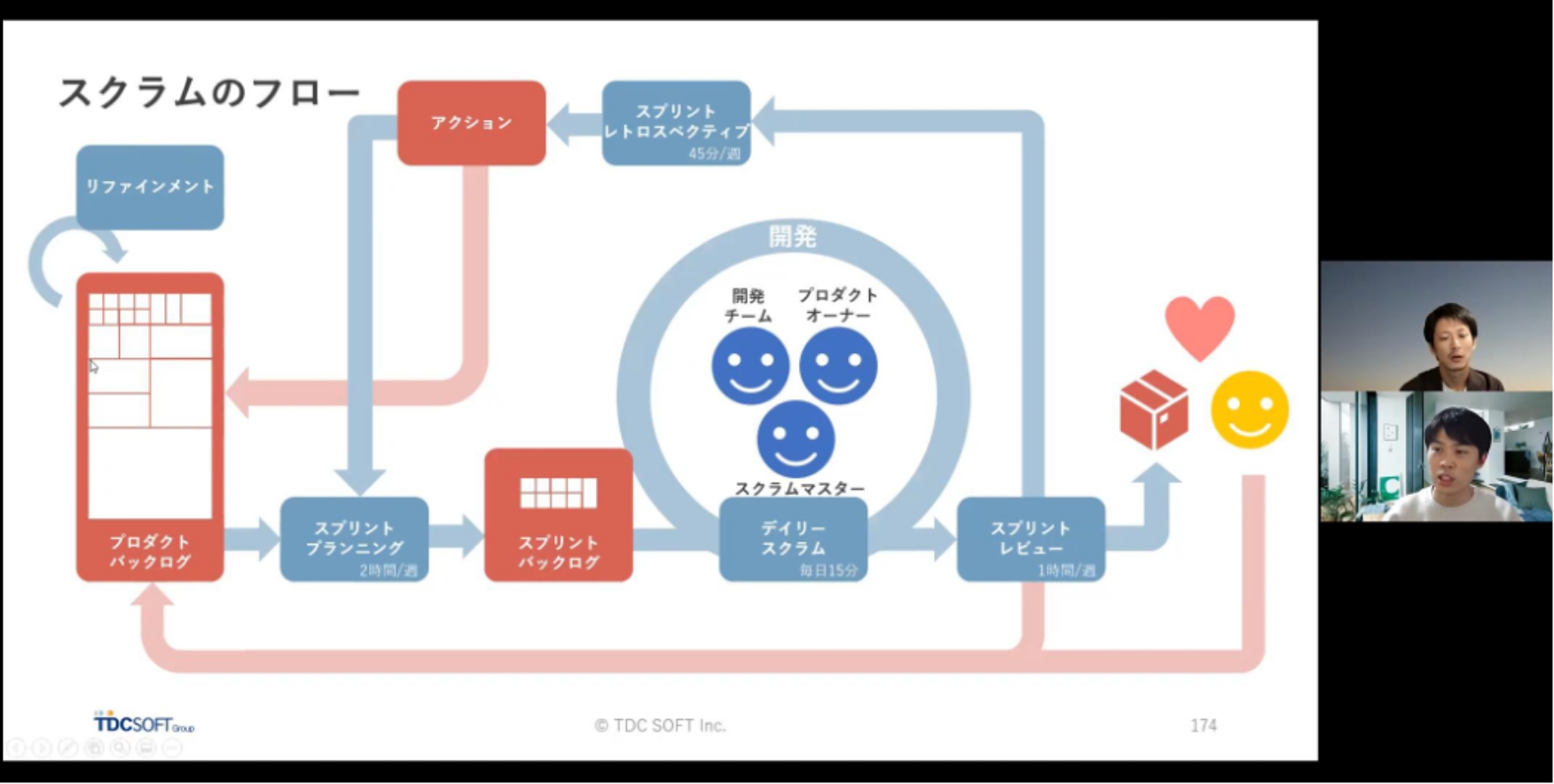
In the last part of the workshop, based on the workshop experience, the participants learned the details of Scrum to be operated in a real project, step by step. Various basic principles were discussed, such as that the duration of a sprint from planning to look back should be fixed, and that increments for stakeholders to evaluate must be created that allow them to make release decisions. He also introduced the roles of product owner, scrum master, and developer. It was emphasized that these teams are completely different from the hierarchical teams that have been common in Japan until now.
The workshop was just after the workshop, and the structure of Scrum applied to actual projects could be easily understood. In addition, it was not just an explanation of “how to do it,” but a detailed explanation of the “meaning” of each step.
Understand the Scrum flow step by step.
summary
Throughout the training, I felt that the content is not specific to program development, but can be applied to a wide range of businesses. No prior knowledge is required, so anyone interested in Agile can take the course and experience how an organization can survive in the age of VUCA. The interactive and open nature of the training, which requires participants to think and act on their own, is also agile in its own way.
A number of positive comments were received, saying that they had gained awareness!
Looking back over a short span of time improves the accuracy of forecasting and improves team collaboration. We would like to incorporate this into our actual operations.
I was able to learn about mindset as well as agile development, which broadened my perspective.
I realized the importance of communication among members, not only in Scrum development.
It was an opportunity to change the way I think about things.
I found it helpful not only for product development, but also for working styles and how to build relationships.
I learned that it is possible to partially incorporate Scrum into waterwall projects.
TDC SOFT Inc. continues to make kaizen improvements to the training itself based on the feedback from these participants. The training program itself is truly agile. TDC Soft Inc. also offers more practical programs and UX (customer experience) design training for those who wish to deepen their knowledge. An 8-minute video showing the overall structure of this Scrum training program, how the training is conducted, and the atmosphere of the participants is available below. If you are interested, please take a look.
I will be in charge of training.
TDC SOFT Inc.
Digital Technology Division
Agile Professional
Service Department Agile Coach Masaharu Ono
Learned Agile as a developer in a Scrum team. He experienced the fun and effectiveness of the process and became a self-appointed in-house Agile evangelist. He has been widely active as a Scrum training instructor, in workshops, and as an intern. Currently, he continues to help teams become more agile as a Scrum Master and Agile Coach.
Technologies Used
agile
We use practical know-how and SAFe®︎ to transform your teams and processes to be agile. We support the creation of an agile and flexible organization that is responsive and unified.
This website uses cookies to improve your experience while you navigate through the website. Out of these cookies, the cookies that are categorized as necessary are stored on your browser as they are essential for the working of basic functionalities of the website. We also use third-party cookies that help us analyze and understand how you use this website. These cookies will be stored in your browser only with your consent. You also have the option to opt-out of these cookies. But opting out of some of these cookies may have an effect on your browsing experience.
Necessary cookies are absolutely essential for the website to function properly. These cookies ensure basic functionalities and security features of the website, anonymously.
Cookie
Duration
Description
AWSALB
7 days
AWSALB is an application load balancer cookie set by Amazon Web Services to map the session to the target.
AWSALBCORS
7 days
Amazon Web Services set this cookie for load balancing.
client_id
never
This cookie is used for passing authentication information.
cookielawinfo-checkbox-advertisement
1 year
Set by the GDPR Cookie Consent plugin, this cookie records the user consent for the cookies in the "Advertisement" category.
cookielawinfo-checkbox-analytics
11 months
This cookie is set by GDPR Cookie Consent plugin. The cookie is used to store the user consent for the cookies in the category "Analytics".
cookielawinfo-checkbox-functional
11 months
The cookie is set by GDPR cookie consent to record the user consent for the cookies in the category "Functional".
cookielawinfo-checkbox-necessary
11 months
This cookie is set by GDPR Cookie Consent plugin. The cookies is used to store the user consent for the cookies in the category "Necessary".
cookielawinfo-checkbox-others
11 months
This cookie is set by GDPR Cookie Consent plugin. The cookie is used to store the user consent for the cookies in the category "Other.
CookieLawInfoConsent
1 year
CookieYes sets this cookie to record the default button state of the corresponding category and the status of CCPA. It works only in coordination with the primary cookie.
mw-wp-form-token
session
This cookie is used to ensure proper operation of the contact form.
rc::a
never
This cookie is set by the Google recaptcha service to identify bots to protect the website against malicious spam attacks.
rc::c
session
This cookie is set by the Google recaptcha service to identify bots to protect the website against malicious spam attacks.
viewed_cookie_policy
11 months
The cookie is set by the GDPR Cookie Consent plugin and is used to store whether or not user has consented to the use of cookies. It does not store any personal data.
wpEmojiSettingsSupports
session
WordPress sets this cookie when a user interacts with emojis on a WordPress site. It helps determine if the user's browser can display emojis properly.
Functional cookies help to perform certain functionalities like sharing the content of the website on social media platforms, collect feedbacks, and other third-party features.
Cookie
Duration
Description
VISITOR_PRIVACY_METADATA
6 months
YouTube sets this cookie to store the user's cookie consent state for the current domain.
wp-wpml_current_language
session
WordPress multilingual plugin sets this cookie to store the current language/language settings.
yt-remote-cast-installed
session
The yt-remote-cast-installed cookie is used to store the user's video player preferences using embedded YouTube video.
yt-remote-connected-devices
never
YouTube sets this cookie to store the user's video preferences using embedded YouTube videos.
yt-remote-device-id
never
YouTube sets this cookie to store the user's video preferences using embedded YouTube videos.
yt-remote-fast-check-period
session
The yt-remote-fast-check-period cookie is used by YouTube to store the user's video player preferences for embedded YouTube videos.
yt-remote-session-app
session
The yt-remote-session-app cookie is used by YouTube to store user preferences and information about the interface of the embedded YouTube video player.
yt-remote-session-name
session
The yt-remote-session-name cookie is used by YouTube to store the user's video player preferences using embedded YouTube video.
ytidb::LAST_RESULT_ENTRY_KEY
never
The cookie ytidb::LAST_RESULT_ENTRY_KEY is used by YouTube to store the last search result entry that was clicked by the user. This information is used to improve the user experience by providing more relevant search results in the future.
Performance cookies are used to understand and analyze the key performance indexes of the website which helps in delivering a better user experience for the visitors.
Cookie
Duration
Description
cookielawinfo-checkbox-performance
11 months
This cookie is set by GDPR Cookie Consent plugin. The cookie is used to store the user consent for the cookies in the category "Performance".
Analytical cookies are used to understand how visitors interact with the website. These cookies help provide information on metrics the number of visitors, bounce rate, traffic source, etc.
Cookie
Duration
Description
__CAMINFO
1 year
Shanon Marketing Platform set this cookie for tracking.
__CAMSID
1 hour
Shanon Marketing Platform set this cookie for tracking.
__CAMVID
1 year
Shanon Marketing Platform set this cookie for tracking.
_ga
1 year 1 month 4 days
Google Analytics sets this cookie to calculate visitor, session and campaign data and track site usage for the site's analytics report. The cookie stores information anonymously and assigns a randomly generated number to recognise unique visitors.
_ga_*
1 year 1 month 4 days
Google Analytics sets this cookie to store and count page views.
Advertisement cookies are used to provide visitors with relevant ads and marketing campaigns. These cookies track visitors across websites and collect information to provide customized ads.
Cookie
Duration
Description
VISITOR_INFO1_LIVE
6 months
YouTube sets this cookie to measure bandwidth, determining whether the user gets the new or old player interface.
YSC
session
Youtube sets this cookie to track the views of embedded videos on Youtube pages.
yt.innertube::nextId
never
YouTube sets this cookie to register a unique ID to store data on what videos from YouTube the user has seen.
yt.innertube::requests
never
YouTube sets this cookie to register a unique ID to store data on what videos from YouTube the user has seen.